
Drew GaitherLior Agni
Menu

Research

I study how people interpret themselves through categories created, negotiated, and enforced by social institutions.

I am a first-year Sociology M.A./Ph.D. student at Georgia State University. My emerging research sits at the intersection of the sociology of mental health, labeling and identity, neurodivergence, and institutional life.

Drew in a formal academic portrait.

I am particularly interested in what happens when diagnostic categories are uncertain, contested, changing, or incomplete—and how people decide which explanations of themselves to accept, reject, pursue, or revise.

My current graduate work is increasingly centered on these processes of diagnostic uncertainty, identity formation, and institutional navigation.

Authority and Meaning

Who gets to define distress? What makes a diagnosis legitimate?

How do clinical institutions, families, peers, online communities, workplaces, and individuals themselves participate in constructing the meaning of mental health and neurodivergence?

Current Research

Emerging Graduate Research

Diagnostic Uncertainty, Labeling, and Identity

How do young adults navigate diagnostic uncertainty?

I am interested in the period before, during, and after diagnostic identification: when people recognize distress or difference, encounter possible labels, seek professional interpretation, receive competing explanations, or continue living without a definitive diagnosis.

Rather than treating diagnosis as a single clinical event, I am interested in diagnosis as a social process—one shaped by interactions among individuals, clinicians, families, friends, institutions, media, and broader cultural understandings of mental illness and neurodivergence.

Areas of Inquiry

  • Diagnostic acceptance, rejection, revision, and pursuit
  • Self-understanding and identity formation
  • Professional versus experiential authority
  • Labeling, stigma, and normalization
  • Neurodivergence and psychiatric classification
  • Engagement with treatment, accommodations, and care
  • Institutional responses to mental difference
Broader Research Interests

My work is connected by a broader interest in how people remain intelligible to themselves within systems that classify, organize, and constrain them.

Institutions and Identity

How organizations and institutional categories become part of personal self-understanding.

Work, Burnout, and Organizational Life

How workplace structures shape autonomy, exhaustion, mental health, and quality of life.

Medical Sociology and Sociology of Health

Particularly the social organization of psychiatric knowledge, care, legitimacy, and classification.

Social Psychology and Symbolic Interaction

Including labeling, dramaturgy, stigma, identity negotiation, and meaning-making.

Political Economy and Inequality

How broader economic and institutional structures shape experiences that are often understood as individual.

Selected Prior Research

These earlier projects and writings helped shape the questions I now bring to mental health, identity, and institutional life.

Previous Research

Shared Burden or Personal Duty? U.S. Public Opinion on Paying for Medical Care Before the Affordable Care Act

Empirical public opinion project · healthcare responsibility · institutional trust · ACA era

This project examined how Americans assigned responsibility for healthcare costs using General Social Survey data from 1996 and 2006. It explored relationships among attitudes toward national health spending, institutional trust, social location, and preferences for individual, governmental, insurance, or charitable responsibility.

Previous Research

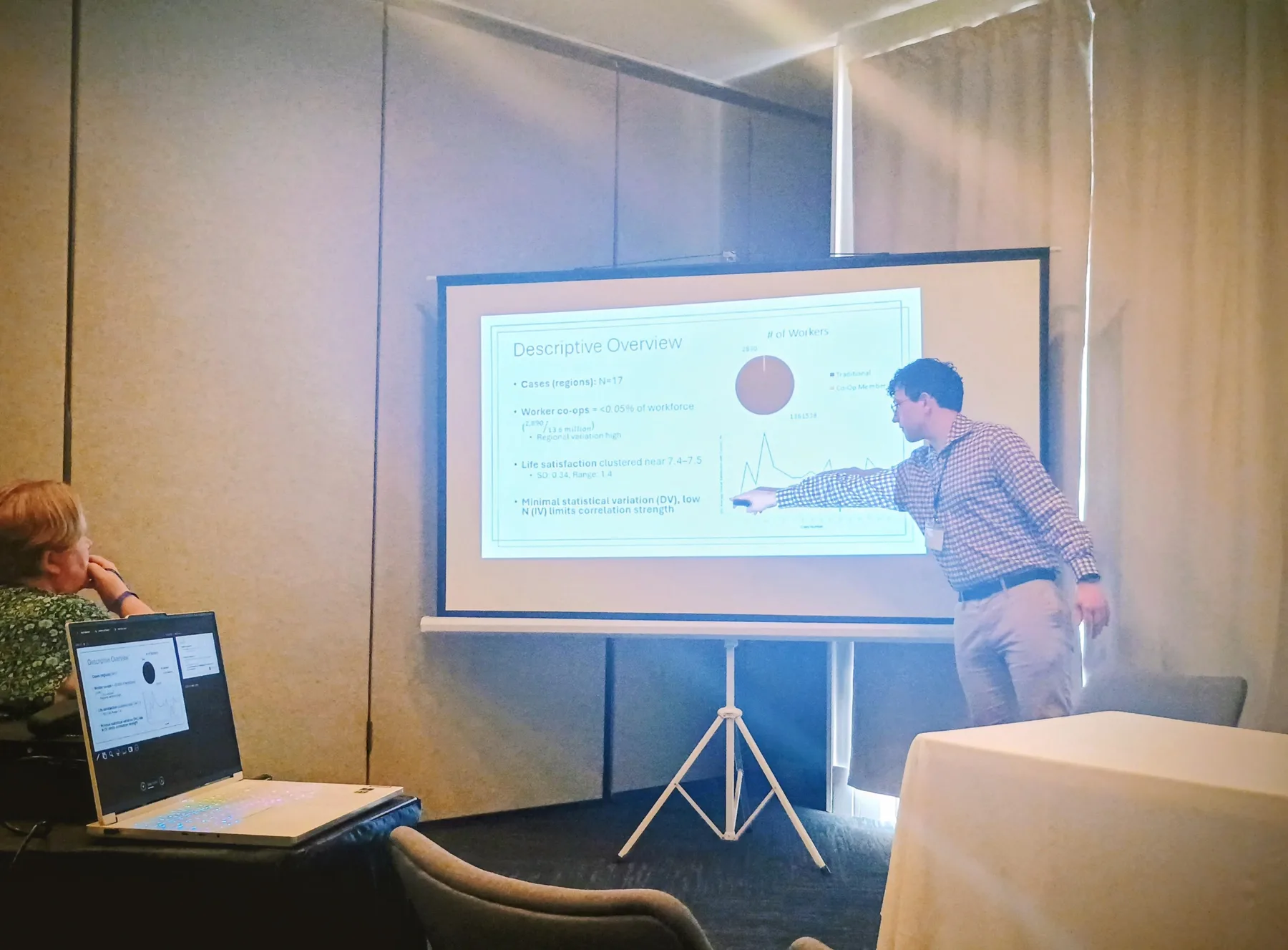
Revolutionizing Economic Dynamics: Exploring the Implications of Worker Self-Direction on Quality-of-Life Outcomes

Mixed-methods research project · worker autonomy · cooperatives · quality of life

An earlier project examining worker autonomy, cooperative organization, and quality-of-life outcomes. The project helped develop my continuing interest in the relationship between institutions, autonomy, work, and wellbeing.

Work as a Neurodivergent Experience

Gaither, 2026 · Sociological report · alienation · emotional masking · burnout

A sociological report on labor, neurodivergence, emotional masking, burnout, and the contradictions of contemporary work culture.

Work Less for More

Public writing · American work culture · productivity · labor and life

A public-facing essay on American work culture, exhaustion, productivity, and organizing life around something more human than labor alone.

Research Approach

My research questions increasingly draw me toward qualitative and interpretive approaches, particularly in-depth interviewing and the study of meaning-making. I am interested in how people narrate experiences that institutional categories do not always neatly capture.

At the same time, my previous work has included quantitative analysis of large survey datasets, and I remain interested in methodological pluralism: allowing the research question, rather than disciplinary habit, to determine the method.

External Profiles & Public Writing

Additional research, seminar work, essays, and ongoing projects live on my public platforms.

ResearchGate

Formal academic work, conference papers, research projects, and developing scholarship.

Visit ResearchGate

Writing Through Fire

Public-facing essays and interdisciplinary writing on labor, mental health, identity, institutions, and human experience.

Featured piece: Theories on Human Interaction

Read on Substack

Research, for me, is not separate from lived life.

It is another way of paying attention.